
Show notes, links and transcript
Show notes and links
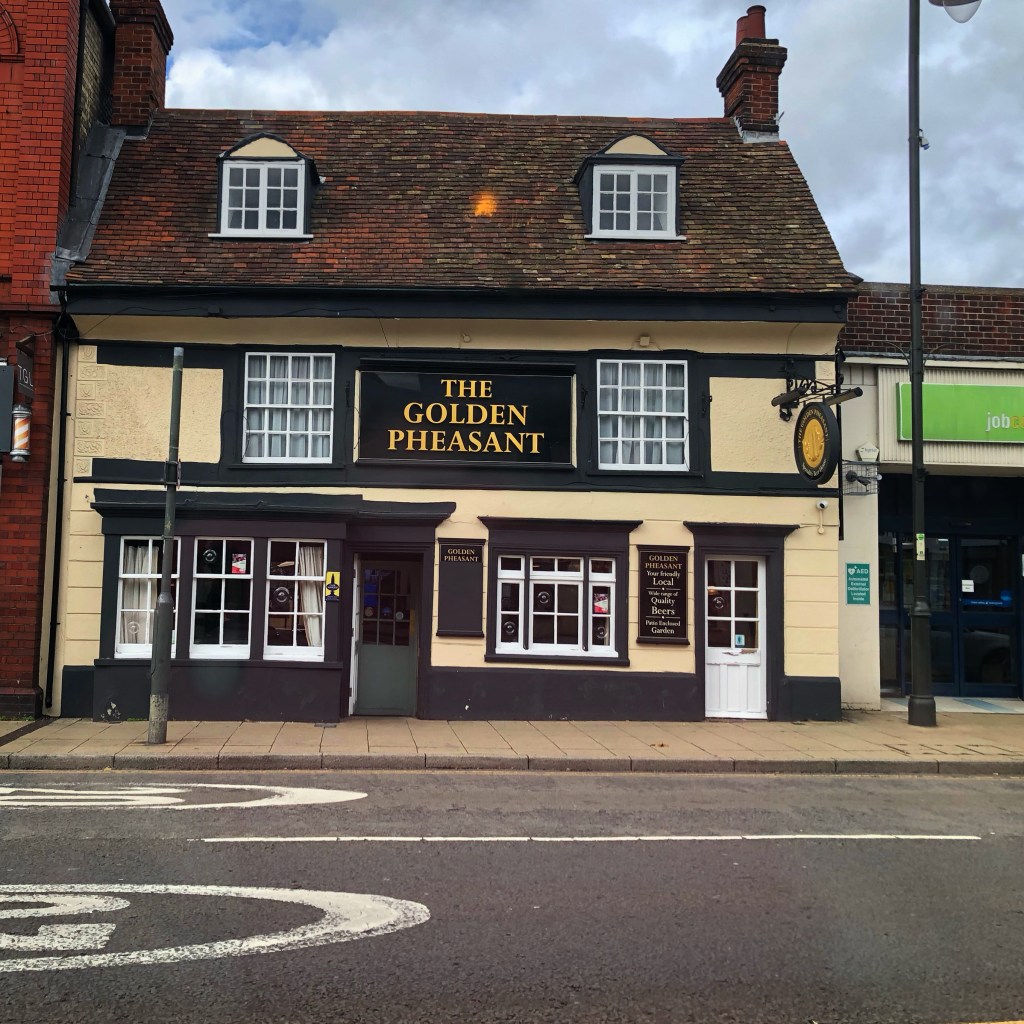
Here’s the website for the Golden Pheasant pub which includes some brilliant old photographs of the pub and Biggleswade high street.
Below is an image of the yard at the Pheasant where William Robinson was taken after his accident. You can also see the strange porch gate with the building to it’s right which was once a morgue. It has beer barrels against it in the photograph.

Bedfordshire May Carol
Said the Maiden’s lock down version of the May Carol on facebook.
British Library recording of the May Carol.
Here’s a detailed blog post all about the Bedfordshire May Carols and customs with a link to a brilliant video about Marjory “Mum” Johnson who kept these carols alive with her folk singing.
Show transcript
Hi, Nat Doig, here. Just a heads up that today’s episode doesn’t just feature scary ghost stories it also includes some gruesome descriptions and discussions of violent deaths.
Dramatic intro
It’s the late 1990s, a dull Tuesday morning in October. Amanda has been working at the Golden Pheasant for a few months now. She’s let herself into the pub and is busy getting the place ready for opening. She’s still not quite used to that smell of sour booze and stale cigarette smoke that greets her each morning. Her boss, the landlord is out at the bank. So, when she first hears it, the sound coming from the bar, she’s puzzled because she knows she’s the only person in the building. She puts down the toilet roll that she was restocking and listens.
It sounds like someone singing. Her first thought is that the front door must have been left open, and someone has stumbled in off the street. But why would they be singing? It’s not even 11:00 in the morning.
Weird she thinks. She leaves the toilets and goes to investigate. Not scared just confused, it’s unmistakable now there’s someone singing in the bar. Amanda heads towards the sound. Steeling herself to deal with this overly keen customer, hoping it doesn’t become a confrontation. As she enters the bar from the passageway, the last few notes of singing drift into silence. She glances around the small, snug room, her heart starts to rattle because the room is empty. She sees no one. She walks over to the front door, tries it but it’s locked. No one could have got past her in the passageway, it’s so narrow she’d have seen them. She even looks under the tables and chairs, the settle, and behind the bar. But there’s no one there.
Amanda shrugs and decides that it must have been someone passing on the street singing, singing very loudly but that’s what it must have been right? Right?
When her boss gets back from the bank there’s a mix up with the crisps order which puts the mystery singing right out of her mind. Amanda doesn’t think about it again until a couple of weeks later….
This time Amanda is clearing up after closing. The pot washer has gone home, and her boss has left to take his dog for a quick walk down to the river in the dark. He’s usually gone about twenty minutes.
Amanda is standing in the passageway at the back of the pub when she again hears the singing. It’s the same voice and song as before she’s sure of it.
This time though she’s determined to catch the culprit. So, she treads very carefully along the passageway towards the bar. The singing gets louder. She holds her breath, heart pounding. All the while the singing continues. It’s not a song Amanda recognises.
It’s coming from the bar for sure, not outside, she can actually hear a group of men laughing as they walk by on the high street and then a motorbike goes past. The singing continues through all of this, the sound much nearer to her and not outside.
She steps silently into the bar, it’s dark, lit only by the eery orange street light that seep through the windows. She knows that there’s no one in there. She knows it but…
The singing is loud now, definitely coming from a little way in front of her and to the right. She dares not turn her head to look but she knows she must. She takes a deep breath; she slowly moves her eyes to the right. And it stops. The singing stops dead and she flips on the light switch to her side and the bar is suddenly bright. She is alone but has that unmistakable feeling of someone having just left the room. She feels the air displaced around her as if someone just brushed past, but they couldn’t have she’d have seen them. She spins around to look down the passage but there is no one there. The door at the end is locked.
Fifteen minutes later, her boss returns to find Amanda nursing a brandy. She’s reluctant to say what happened, doesn’t want to look foolish but something in her boss’s calm face encourages her. It’s as if he expected this. Like he’s dealt with finding his staff in shock nursing a brandy before. As she explains what happened a fortnight ago and then just now, she doesn’t see anger or disbelief on her boss’s face instead he nods and smiles sympathetically. He pours himself a whisky and says that she is not the first.
“The first thing I need to tell you Amanda,” he says calmly “Is that whatever you heard is completely harmless. No harm has come to anyone who’s heard or witnessed strange things in the pub. But you’re not the first and I’ll admit I’ve heard the signing too. Drifting up from the bar at night when I’m in the flat. The first time I heard it I came down to investigate, honestly I thought we’d locked someone in over night and they’d helped themselves to as much booze as they could and were blotto. But no there was nothing. No one in the pub. I’ve heard it twice since, and there’s never anyone there. I know a former barman has heard it and a few customers when it’s been quiet have complained about the singing and yet no one in the bar has been making a sound at the time.
It’s not like we have music playing in here, is it?
I’ve heard footsteps too in the passage there, great clattering footsteps but there’s never anyone actually making them. Not visible anyway!
I was told when I took over here that any funny goings on, you know when you’ve just put on a new barrel, but nothing comes out. When the taps get turned on by themselves, the odd glass falling off a table when no one is near it, that kind of stuff. Well, I was told that was all down to Maurice a former landlord here in the 1930s. I don’t know if he was a singer.
The other story I’ve been told is a darker one, an older one. About this place a hundred years ago. Back in Victorian times this pub was the town brothel and well a poor woman who worked in the brothel was run down by a carriage one night. Some say she was running away from here; others just say it was a terrible accident. But they say her restless spirit is the cause of the haunting. But I don’t know, it’s just a story.
But remember none of it can harm you. It’s just a bit odd.”
Amanda shudders, odd is one word for it she thinks.
Welcome
Hi, I’m Nat Doig and welcome to this Halloween special episode of Weird in the Wade, all about the Golden Pheasant Pub in Biggleswade. Could it be the town’s most haunted inn?
The introduction you just heard is made up of several stories that have been told about the ghostly singing heard by staff and regular drinkers in the pub over the decades. It’s a fictionalised account of those reports. I’m not aware of anyone called Amanda working at the pub, she represents all the staff and regulars who have had tales to tell. Similarly, I don’t know if any of the landlords over the years have experienced spooky goings on themselves but he tells the stories that I’ve heard about the Pheasant. Because I have spoken with several people who have reported to me various stories, which I used to create that opening sequence for you. More on that later.
I have a big thank you to say before we dive into the episode. I’d like to thank the current staff and regulars at the Golden Pheasant who shared their thoughts and stories with me back in September. I joined them for an hour one Monday and they were very generous with their time. And if any former staff or regulars are listening and want to contribute your own stories I will do an update on this episode so please do get in touch with me at weirdinthewade@gmail.com or on social media just search weirdinthewade. We’re on insta, threads, twitter or X and bluesky
Whilst researching for this episode I experienced at least three occasions where my blood ran cold because of what I uncovered. This includes a possible explanation for the singing that is heard or for the persistent story about it. I’ve also uncovered details of a terrible accident that did befall a 19th century prostitute in Biggleswade which corroborates details of the ghost story I heard when chatting with the drinkers and staff at the pub. Details I’d not come across before in any of the other stories about this tragic death. Hold tight because you’re in for a twisty turny terrifying ride through ghost stories and history!
But first some thoughts on Ghost Stories
I’ve noticed something with local ghost stories, and I am sure it holds up for other ghost stories too. They seem to fall into one of two categories which I think of as
Phenomena driven or History driven.
I’m sure the wonderful academics who study this kind of thing have a proper name for it. But this is how I explain it. The haunted pound stretcher story we covered in episode one is phenomena driven. The women who worked in the shop experienced some very unsettling phenomena. Those who heard their stories and the women who experienced the activity, then tried to find some historical context for them, so did I. But the phenomena came first, any theories tying it to actual historical events or people has kind of failed to materialise so far. A lot of famous poltergeist cases fall into this category like the Battersea poltergeist for example.
But if we look at the Potton Poisoner case, the history of Sarah Dazley definitely came first. The Wrestlingworth murders shook the whole country not just the village and it seems that strange phenomena that occurred after that point was attributed to the restless spirit of Sarah. Like an echo of the very real tragedy pulsing outwards through time. Just think how the children of the village kept alive Sarah Dazley’s story in an age before the internet. So that thirty years ago, 150 years after the murders, the Potton Poisoner was still remembered through the ghost story. The children of the village kept away from her cottage, after night in case they came across her malevolent spirit and her phantom baby. Ghost stories attached to historical buildings like the Tower of London often fall into this history lead category.
Sometimes the most thrilling ghost stories are ones where the phenomena comes first but it is then successfully tied in with some long forgotten historical events. It gives credence to the story somehow, whether you believe in the existence of ghosts or not. A sceptical interpretation to this might be to marvel at how events have been kept alive through ghost stories long after the facts of the real life case have been largely forgotten. For those who believe in spirits will see the historical evidence as proof of a basis for the haunting.
And there are two ghost stories associated with the Golden Pheasant, that fall into these opposite camps. One is phenomena driven. One is a sad story of a tragic death. Both are entwined. Yet I’ve found two real news stories from 1870 and 1900 which are not connected in any way but relate to the Golden Pheasant’s ghost sightings in very different and compelling ways.
Are we dealing with a history driven ghost story here, though the actual events have been long forgotten? Sometimes these kinds of tragic stories get altered in the recounting, for good reasons. For better story telling reasons. Sometimes its just time wearing away the corners, smoothing down the edges of the facts. But at the heart of the ghost stories there’s a real-life tragedy that is still being remembered and possibly still being experienced by the witnesses.
There’s been a plethora of phenomena reported at the Golden Pheasant over the years. And this pub was for a long time, the premier location if you searched for hauntings in Biggleswade. It was featured in Damien O’Dell’s Ghost stories of Bedfordshire book twenty years ago. It features in the Bedfordshire libraries ghost story pamphlet, its included in several paranormal databases. If you ever ask on social media for local ghost stories to Biggleswade the Golden Pheasant is always mentioned, even before the haunted pound stretcher is. So, let’s have a look at the pub, the stories and the evidence I’ve uncovered.
The Golden Pheasant
It’s not the oldest surviving pub in Biggleswade, that prize goes to the White Hart, which sits almost opposite the Pheasant. The White Hart looks the part, all wood beams and dark diamond latticed windows. The Pheasant looks unassuming in comparison. It’s small, almost dainty, a bit crooked and painted a warm cream. It often has exuberant hanging baskets adorning its front though currently it doesn’t. Its sign is impossibly shiny gold that stands out clearly on the High Street. Inside it is surprisingly small and cosy with the bar taking up the back right hand corner of the room as you enter from the High Street. It’s a simple bar space, tables chairs, men sitting at the bar on high stools. It specialises in real ales. It’s a beer drinkers pub. Opposite the front door is a long corridor leading out to the back yard and the Pheasan’s other entrance from Church Street. That entrance has a strange porch over a gate and a small barn like building attached to the porch. I was told by drinkers in the pub that this building was once used as a morgue.
The Pheasant was built in 1751 and survived the great fire of Biggleswade 30 years later, in some form at least. It was a shop and then in the 1850s was granted its licence as a pub and brewery. The brewery was eventually purchased by Sam Wells. In 1869 Walter Wren took over as licensee along with his wife. And the Wren’s were in charge when both tragedies struck. But let’s look at each case separately and then consider how they’re tangled up together with the ghostly phenomena.
As you heard in the opening portion of the show, the most prevalent story associated with the Pheasant is that of ghostly singing. A story about ghostly singing in the pub was first told to me years before I started the podcast by a friend who has a relative who worked at the Golden Pheasant. This relative reported hearing singing in the bar when it was completely empty. They were at great pains to point out that there was no juke box nor radio there at the time, and that the TV was definitely not switched on either. This ghostly singing has been heard by many people who work or visit the pub it is told.
I’d also heard that the pub had previously had a brothel above it and that a woman who worked at the brothel had been killed in a horrific accident and that she had been reportedly seen in the pub in the past. Details on this haunting were more scant. Though the nature of her death was sometime attributed to being run down by a carriage out on the street.
When I started researching this case I never expected to find two actual historical events, thirty years apart that could relate to both these stories, the ghostly singing and the accident. But I did.
A shocking result of Public House Joking
When I searched the newspaper archives for stories about the Golden Pheasant, I assumed I’d find mainly news about darts teams or maybe adverts for entertainment on a Saturday night. So, I’ll be honest with you, when I came across a news article about a tragic death in 1900 associated with the pub I was really intrigued. And then as I read on, I discovered that the death related to singing in the pub. My blood ran cold.
The story I found is so sad and almost trivial in its “this could happen to you” quality that it makes it even more poignant.
The events took place on Friday 13th July 1900 at around 11pm at the public bar of the Golden Pheasant. Yes Friday 13th. It seems the night had been a fairly typical one. Mrs Wren the landlady was in the sitting room reading though she had been serving drinks earlier. There were a group of regular drinkers enjoying each other’s company. And as one headline put it what happened on this normal evening was “A shocking result of public house joking.”
In the main bar of the Pheasant that night was a young man named Arthur French. He was 20 years old, a year away from getting married. He’d been born in Ware in Hertfordshire and now boarded with the Becks a couple in their 50s on Back Street in Biggleswade, literally a stone’s throw from the pub. Arthur worked as a fish cutter and curer. And young Arthur appears to have been a lively confident lad who for entertainment that evening started singing a song, standing in front of the fireplace. In a time before juke boxes, and other electronic entertainment singing was a popular pass time in the pubs.
We don’t know what Arthur sang though the coroner investigating the death did inquire of a witness what the song was, but an answer was not forthcoming, the witness said he was more of a dancer than a musician and so did not know the name of the tune.
But I wonder if Arthur being just 20 was singing one of the latest music hall numbers, a song like Daisy, Daisy, give me your answer do. It was only a year since it had made its debut in the theatres and would have been popular with the young working people who enjoyed the music hall. Maybe it was particularly popular in Biggleswade with its association as a bicycling town. I can only speculate. Maybe young Arthur was into opera? We’ll never know for sure.
What we do know is that not everyone was so keen on either Arthur’s singing or his choice of song. In the pub that night there was also a 60 year old man named William Robinson. Robinson has perhaps my favourite job description on a census form that I have ever read. In 1891 he is listed as being a chicken higgler and hawker. A higgler was like a pedlar as in someone who travelled the country selling his wares. Up until 1890 Biggleswade born Robinson had worked as an agricultural labourer. Maybe now that the majority of his large family had left home or become established, he had branched out into the chicken business. His two eldest sons had done well for themselves one becoming a groom the other a blacksmith’s assistant. His two eldest daughters worked as seamstresses.
But William Robinson who by all accounts knew young Arthur French and got on well with him, objected to Arthur’s singing that night or to the song.
Witnesses described the whole scene as being good natured. And it seems that William Robinson felt comfortable getting up out of his seat to dance about the young lad as he sang, dancing or moving in a silly way as if to tease him. I imagine a bit of Dad dancing going on here. The mocking dancing not enough to stop French’s song, Robinson accused French of not being able to sing and launched into his own song in front of him.
I can imagine this scene being played out today.
“Call that a song Arthur? You want to be singing something tradition, tried and tested, none of this modern nonsense! Something like this … ”
And so, in the pub that night we had a Victorian version of a rap battle. With each man competing with the other to sing their chosen song.
French is described as good-naturedly pressing Robinson back down into his seat. Putting the older man back in his place.
“Sit down grandad leave it to those that know how.”
But to no avail. Robinson sprung up again on to his feet, belting out his preferred ditty.
This time he skulked about the young lad strutting like one of his chickens, to the amusement of those looking on. Though the impression given by the witnesses at the inquest was that no one was paying them that much mind as they were being friendly and often joked in this way. This wasn’t anything too out of the ordinary for the Pheasant on a Friday night.
Robinson still not content to compete with the younger man, placed his hand on Arthur French’s shoulder and this is where the witness statements become a little bit hazy. What can be deduced is that both men began to grapple with each other, almost as if they were dancing, clowning about, taking the singing battle a step further. Except the tussle spilled out into the passage that runs through the back of the pub. And it was in the passage that one or both of them lost their footing and they both came tumbling down with a crash on the brick floor.
Their horse play now causing the landlady Mrs Wren to get up from the sitting room where she was reading the newspaper, to find out what the commotion was all about. Charles Albone had been called to help lift William Robinson up by French who was unscathed from the fall. Robinson on the other hand was dazed. There are reports that he had a walking stick which had been snapped in two by the fall. It was unclear who had fell on top of whom. Though it was clear that unlike French, William Robinson was not able to just get up and brush himself down. Mrs Wren tried to revive Robinson with a damp flannel. She knew he wasn’t drunk. He’d not ordered more than half a pint all evening, she testified. He wasn’t intoxicated.
He was described as groaning and being unable to sit up in a chair properly. He was carried outside to the back of the pub into the yard, with the hope that the fresh air might bring him to his senses. One witness said it was like he had had a seizure of some kind.
Eventually he was taken home by a couple of men and left in front of the fire in his living room. His wife Sarah doesn’t appear to have been told that he was injured or if she was told anything it was just that he’d taken a tumble. Sarah Robinson assumed her husband was drunk. He occasionally came home worse for wear with drink, less so now that he was older, but she’d seen him drunk plenty of times and she’d leave him to sleep in front of the fire when he was in that state. She’d called to her son, to come and help her with him, but her son assuming his dad was just drunk again refused, he had work the next day.
It was only when Sarah woke the next morning and found that her husband had not got up or even moved to take off his shoes, that she realised something terrible was wrong with William.
A doctor was called but sadly William Robinson, father of at least 8 children and many more grandchildren, died just after lunch time that day.
As you can imagine such a strange tragedy was the talk of the town. It appears that there were many rumours swirling. The inquest was held a week after the incident when memories were still fresh. The witnesses give consistent reports of what happened though they differ in slight details. The exact time of the accident seems to be hard to pin down, anything from 10:45 -11:30. Who helped Robinson up is also disputed. Some say it was French others say it was Charles Albone. Sarah Robinson claims her husband had a black eye the following morning, but no one in the pub remembers seeing any bruising or swelling then.
Doctor James who treated Robinson on the Saturday and carried out a postmortem agreed that there was bruising to Robinson’s left eye. He also found a 6 inch skull fracture from the left eye socket to above the left ear. Beneath the fracture was much pooled blood and a blood clot was also found. Death was attributed to a head injury and concussion. The doctor believed that the injury was consistent with William falling and hitting his head on to a stone or brick floor as had been described by the witnesses.
The jury spent only a few minutes conferring and passed a verdict of death by misadventure. Much was made of the fact that Arthur French had volunteered to give evidence at the inquest and done so in a clear and straightforward way. All the witnesses agreed that no tempers had been lost that tragic evening and that French and Robinson had just been fooling about. The older man had been teasing but in a good-natured way and French had not intended to hurt William Robinson. Arthur French had his whole life ahead of him, he was just 20. It seems the opinion of those there on the night was that his life should not be ruined by a silly bit of horse play in the pub that went horrifically wrong. Though the newspapers hint that until the evidence was heard at the inquest the town had other ideas as to what had happened. We never find out if the inquest truly quelled those rumours.
The broken stick does make me wonder if being hit with such an implement could cause a 6-inch skull fracture. I also wonder just how good natured their dispute really was? We’ll never know if the regulars in the pub played down the events in a bid to protect the young Arthur French. I think we can safely say, French certainly didn’t intend to kill anyone.
But what we can’t ignore is that 123 years ago a dispute over singing in the pub ended in a tragic death. Is it the singing of William Robinson that is heard in the Golden Pheasant when the bar is empty? Does his spirit return to the site of his horrific accident and sing to his hearts content where no one can stop him. Or is time somehow replaying the tragedy. Competing singer’s voices rippling through time? Footsteps have also been heard in that passageway when there is no one there. The passage where William hit his head. Or has a fragment of folk memory, kept this tragedy alive through a story about ghostly singing? What at first was remembered as a tragic death over a dispute about singing, morphed into a spookier story.
Whether it’s the singing spirit of William Robinson, a kind of timeslip or a fragment of folk memory, have we solved the tales of ghostly singing in the Golden Pheasant?
Ah if only it was that simple. You see many of the reports do not say whether it was a man or woman’s voice singing just that it was a voice. But there are reports that definitely say that it is a woman who is heard singing in the pub.
Another terrible accident
And there is a tale of a ghostly woman who haunts the Golden Pheasant though why her ghost would be singing is unclear.
It is said that the phantom is of a woman who worked in the brothel above the Pheasant during the 19th century and who met a very gruesome end in a terrible accident. I’d seen one person say she had been run over by a coach or carriage on Biggleswade High St.
So, I did a search for carriage accidents through out the 19th and early 20th centuries in Biggleswade. But nothing came up that fitted. There were a couple of accidents with small children and cyclists with carriages, but none were fatal, and none were linked to the Golden Pheasant.
Now one thing that was always stated in these stories was that the woman who died had worked in the brothel as what now we would now call a sex worker but in Victorian times she’d have been described by the euphemism of an unfortunate, or lady of the night, or just called a prostitute. So, I searched for deaths with those Victorian key words in Biggleswade and experienced my blood running cold for a second time because I found news stories for 1870 reporting the tragic and gruesome accidental death of what the majority of the newspapers called “an unfortunate” and the young man who was with her. A few of the bolder newspapers referred to her as a prostitute.
This poor woman and her customer or client did not die in a carriage accident though, they in fact died on the railway lines in Biggleswade. Hit by a fast goods train as they tried to cross the lines just north of the train station.
It seemed like I might have found the source for the tragic back story for the second Golden Pheasant ghost. I could imagine that over the years the being hit by a train morphed into the more Victorian sounding hit by a carriage. And well trains have carriages don’t they. But I didn’t have any evidence linking the case to the Golden Pheasant. Was it really the town brothel?
It was one of the main things I wanted to ask the staff and regulars at the pub when I visited in early September, and they were able to fill in pieces of the puzzle for me beyond just that.
All the regulars and staff confirmed that yes, the Pheasant had been the town brothel. There was no doubt in their minds. It was just common knowledge. I felt more reassured, though I’d love to find some actual evidence. I may have to scour 19th century police reports to confirm it though.
The next piece of information that I was given, by the regulars, staff and occupant of the flat above the pub, was the third time my blood ran cold. Now the men I spoke with had all heard the tale of the carriage accident. I explained that I’d found no carriage accident, but I had found a train accident. They agreed with me, that it could just be one of those things that got twisted over time. Train carriage, horse drawn carriage. We sat and contemplated our drinks for a while.
I said I’d been shocked by the level of detail given in the newspaper articles about the accident, because it was far more graphic than would be covered today.
It was then that the occupant of the flat above the pub said “Well that particular ghost, she’s headless. The poor thing was decapitated in the accident.”
And my blood ran cold because that is one of the many gruesome details given in the newspapers about the horrific accident. The poor woman was decapitated by the train. Yet I’d not heard that detail in the ghost story previously. I think the colour actually drained from my face as I sat there at the bar.
No one I spoke to at the pub had actually seen or heard anything relating to this haunting or any other at the Pheasant themselves. Well apart from one, he claimed straight away that he’d not experienced anything spooky whilst living at the pub, but he did say that his dog didn’t like to go anywhere near the door at the top of the stairs to the cellar. It seems that a bit like the fact that the pub was once the town brothel, it’s just always been common knowledge that the poor woman who died in this accident haunts the building still. I’d love to know if anyone has actually seen this ghost or experienced anything in the pub beyond the strange singing. The story of this headless ghost who worked in the brothel and died in an accident is so well known it has to originate somewhere? And maybe it’s an example of a real historical event being remembered but as a ghost story.
So, who was the poor woman killed so horribly, and what really happened that fateful night in 1870?
Her name was Ann Larman and she was born in Henlow a few miles south of Biggleswade, in around 1840. The 1841 census records her address simply as opposite the gravel pits. She is a middle child in a family of at least 6 children. Her father Joseph is described as a gardening or agricultural labourer and her mother is named Mary and she works in the home as a straw platter until her death at some point in the 1850s.
By 1861 when Ann is 20 she is still living at home working as a straw platter with her older sister, her father now a widower. Straw platting was a local home industry the straw plaits were used for hat making. In the 1850s it was estimated that around 50,000 women and children were working as straw platters in Beds, Herts, Bucks and some parts of Essex and Suffolk. Straw plaiting featured in the 1851 Great Exhibition and the hats made from the straw were exported all over the world. It was one of the few home based industries left at this time in rural England. It was hard work though and as the straw was treated with sulphur and was passed through the front teeth in the process of plaiting it did a lot of damage to the teeth of both children and adults who worked in the trade.
We don’t know what made Ann leave her home in Henlow and seek work in Biggleswade instead. She doesn’t appear to have ever married. What we do know is that in 1870 she was considered by the inquest into her death to be an “unfortunate” or a prostitute. How they come to this conclusion I am not quite sure. The inquest reports are fairly scant on detail about Ann.
Her brother Edward tells the jury that he identified his sister from her remains which had been carefully collected by the railway workers in the small hours of the Tuesday morning. This must have been an extremely distressing ordeal for him. He confirms Ann was about 30 years of age and born in Henlow though lived in Biggleswade at the time of her death. Some newspapers also report that Mrs Matilda Rook of Palace Street (which is close to the railway station) gave evidence that Ann had visited her on the evening of Monday 13th June until about 11pm when there came a whistle from outside and Matilda heard Ann talking with a man who she then left with. Although the newspapers only comment on Mrs Rook’s husband’s line of work as a labourer on the railway, the census says she was also a straw plaiter and I wonder if Ann wasn’t also working some of the time in her old trade also. Is that how she knew Matilda Rook? We’ll never know. But Matilda was the last person still alive to see Ann that night.
Ann was not the only casualty of the accident, the man she met with, Thomas Baston was also killed. The newspaper reports say he was a carpenter originally from Oxford. I can’t find any definitive records for a carpenter with that name from Oxfordshire. So, I don’t know how old he was. The little we know is that a fellow carpenter named Robert Wormsley had known Thomas for three months. He had the grim job of identifying the body. He confirms Thomas was a fellow carpenter who worked at Lord Peel’s mansion, up at what’s now the RSPB Lodge in Sandy. Thomas clearly knew Ann Larman as a witness saw them together back at the end of May during the Whitsun holiday. But sadly, that is all we know about Thomas’ life.
On that Monday night he was seen by three men near to the New Inn on the market square, he stopped to speak with them a while before heading off through the New Inn yard towards Palace Street. One witness claims he saw Thomas meet with a woman on the other side of the yard. Not knowing exactly where Matilda Rook’s house was, I can’t be sure if this was Ann but it seems likely.
From Palace Street they must have walked towards the train station. They clearly wanted to cross the railways lines. The safest crossing was back in town over the railway bridge but it seems that they were heading towards either the fields on the other side of the railway lines, or possibly towards the pub on London road that wasn’t far from the work house. If this meeting was indeed for an illicit assignation, then this would explain why they didn’t want to be seen together in the centre of town.
There was no railway bridge or official crossing at the railway station in Biggleswade at the time. I’m guessing that to get from one side of the station to the other, to the different platforms, passengers had to cross the lines in the station. This was a far more common thing to do in the 19th century. 19th century maps clearly show that four railway lines run through Biggleswade as they do today but there was no bridge at the station.
Ann and Thomas decided to cross the railway just north of the station. They got halfway across, and a slow goods train came past them heading south towards Arlesy. It was then at 11:22pm the fast non stopping goods train to Manchester and Liverpool came through, hitting them both where they stood on the rails. The driver was only aware of the accident when glass from a headlamp broken in the collision hit him in the face. He stopped the train and walked back down the rails to find clothing and then body parts strewn along the line.
I’ll spare you the details which the Victorian newspapers print in full. Thomas and Ann’s remains are gathered together and taken to the porter’s room at the railway station where first a doctor and then the hurriedly convened inquest jury observed them. The doctor reports at the inquest that Ann’s head was completely severed from her trunk, so we know that part of the story is in fact true. Then the witnesses who identify the bodies are also shown the remains. I am quite amazed by the almost ruthless efficiency of the Victorians. The accident happened on the Monday night at 11:22 by the afternoon of Tuesday less than 24 hours later, an inquest has been heard and the deaths declared accidental.
However, the jury add a special recommendation to their verdict. They recommend that a safe crossing like a bridge, is added to the railway line at the station to avoid this kind of accident happening again. Sadly, it was some decades until such a crossing was added to the railway at the train station. Well into the 20th century I believe.
It’s a tragic story of a life cut short but there’s nothing explicitly linking Ann Larman to the Golden Pheasant, just the manner of her death and the fact that she is reported by the press as being a prostitute or unfortunate. If the Golden Pheasant was a brothel, why wasn’t she working there that night?
Maybe she did work at the Golden Pheasant sometimes. Maybe if she liked a customer though, she’d sometimes see him on her own terms, away from the pub, and that way not give a cut of her earnings away?
I doubt we’ll ever find out the truth. But it seems quite a coincidence that there’s a ghost story about a headless woman haunting the Pheasant, a woman who worked in the brothel there and who came to a grisly and untimely death in a terrible accident that decapitated her. And there’s a real woman named Ann who was a sex worker, but was also a sister and a daughter, had a friend named Matilda Rook, who plaited straw for other ladies’ bonnets, and was killed by a fast goods train in an horrific accident that severed her head from her body.
Singing
But is Ann our singer? Some say it is a woman who sings. But why would Ann’s ghost be singing? And I was told a story when I visited the pub that adds another layer to the story of the ghostly singing that rules out Ann and William Robinson.
This story happened at least 17 years ago because it involves a former resident of the flat above the pub. The current occupant told me this tale though he has not experienced anything like it since he has been living there.
The former occupant reported waking one night after falling asleep on the settee in the living room to the sound of singing coming from the corner. They lived alone in the flat and so maybe even more disconcerting for them, the singing was that of a child. They were shocked by the sound more than scared. Shocked and confused. They looked over into the corner of the room where the childlike singing was coming from and saw a little girl just sitting there. I don’t have a description of the girl. The story was told to me in a way which made me think that the person who witnessed it was scared yes, but mainly shocked. Like what the hell?! What’s a little girl doing in my living room! And then she just disappeared. The little girl has not been seen or heard since.
It does feel like we’ve got a whole choir at the Golden Pheasant now. There’s William and his singing battle, there’s possibly Ann, her head held under her arm singing away and now some little ghost girl of bygone days singing softly to herself in the dead of night in the corner of the living room. No wonder the pub doesn’t need a juke box or music piped into the bar!
Conclusions
What really thrilled me about this case was that after reading and being told the initial ghost stories about singing being heard in the pub I was able to locate an actual tragic death that was linked to singing. I can’t see that one being a coincidence I really can’t. I don’t know if it’s William’s ghost or some kind of time slip phenomenon, but I know that the rational explanation is that it’s a story half remembered that some how warped into a ghost story. I can just imagine how it came about.
Picture it now, a dark winters night in 1910 regulars of the Pheasant are sharing stories and someone says “Remember that night William Robinson died after getting into that ruckus over singing here?”
“Aye, that was a terrible tragedy, a terrible one”
“He liked a song did William.”
“I can hear him now”
Fast forward to the late 1930s and some younger men, sons of the men chatting in 1910 maybe are sharing stories themselves, maybe to distract themselves on the eve of the second world war. Maurice the landlord listening on as he polishes glasses.
“My Dad used to tell a strange story about a chap who died here on an account of signing.”
“Oh yeah I heard that one too, old Arthur French the fishmonger was involved I heard.”
“Yeah, my Dad always said he could hear that chap who died singing you know, his voice really haunting like.”
And fast forward to the 1970s and now it’s a haunting not just a haunting remembrance of the singing. Time wearing away the corners of the story, buffing up the edges.
Except I’ve met someone who knows nothing of William Robinson and Arthur French and who’s close relative swears she heard singing coming from the bar when no one was there. There is a phenomenon being reported which is backed up by a historical event. And that I just find really intriguing.
And what of poor Ann Larman and Thomas Baston? Well, the ghost story was never phenomena driven. I’ve not read about or spoken with anyone who’s seen a headless woman in the pub or experienced anything that is linked to the events. Instead, I think we have here a tragedy remembered and entwined with the ghost stories associated with the pub. We’ll never know if Ann ever worked at the brothel at the Golden Pheasant or drank there. But it’s likely she may have had a connection. That she was associated with the pub.
If you have any information about the haunting at the Golden Pheasant, please do get in touch. Contact details are in the show notes.
One thing that connects both deaths that is a little spooky is that they both took place on the 13th of the month. In fact, Friday 13th June 1900 was unlucky indeed for William Robinson.
Another connecting factor is that they were both deaths which technically could have been prevented. If William and Arthur had not got so rowdy William would not have fallen and hit his head. If Ann and Thomas had crossed the railway line in town over the bridge they’d have not been hit by a train. They were untimely, preventable deaths and maybe that’s why they lived on in people’s imaginations or maybe it’s why their spirits cannot rest.
One last thing
On my visit to the Golden Pheasant I was told one other ghost story. It’s not about the Pheasant but another pub, now closed down and converted into housing. The chap sitting next to me at the bar told me the story first and promised that his mate would be joining him in the pub in a few minutes. I was to ask him about this story when he arrived as corroboration of the details as they both witnessed it.
This strange incident happened at the Coach and Horses on Shortmead Street in Biggleswade about 15 years ago. It was a normal afternoon, and they were only one pint into their drinking so in no way were they drunk. In an alcove in the pub there was a fruit machine. No one had been playing it and it had been just standing there idle since they’d arrived, lights flashing but nothing that drew their attention. Until the fruit machine started moving. Moving back and forth all by itself. They described it as rocking violently like it was dancing. Nothing else in the pub moved at all. There were no lorries going past on the road outside. There wasn’t an earth tremor. It was just the fruit machine rocking back and forth as if it was about to launch itself across the floor. And this wasn’t the loud rumbly noise and movement you get when you hit the jack pot. This was the machine physically jumping forwards and backwards. Everyone in the pub witnessed it and were stunned. After what felt like a long time but was probably a minute the fruit machine stopped rocking and went still again. A few of the drinkers then got up to have a look at it. I can imagine them approaching this dancing fruit machine quite tentatively at first in case it started stomping around again. But it didn’t. They tried to move it, to see how easy it was to tip it or rock it back and forth. And they couldn’t the fruit machine would not budge.
When the chap’s mate did arrive at the Pheasant, I asked him about it, only saying, “I’ve heard you’ve got a strange story to tell about the Coach and Horses?”
He didn’t need any prompting from his mate and immediately retold the fruit machine story, saying it was a really strange thing to witness.
It’s not the only tale of a pub or an item in a pub shaking in Bedfordshire. In a future episode I’m going to tell the story of the Bell at Odell which was plagued by earthquakes in the 1840s and investigated by scientists, magistrates and doctors of the day. The village has a fascinating history which also includes devilish claw marks on the church door. I’m hoping to team up with Lost Pubs of Bedfordshire, to tell the tale of the Bell and Odell village. Lost Pubs of Bedfordshire have a new book out and will no doubt be interested in the story about the Coach and Horses too. Links to there website and socials are in the show notes on the blog.
And talking of devilish claw marks on a church. Our next episode due out on Monday 27th November is about an infamous Bedfordshire church which found itself the subject of salacious tabloid newspaper stories throughout the 1960s -80s. St Mary’s Old Church at Clophill was reputedly the site of devil worship, desecration, and ghostly goings on. But is there any truth in those tales and what has become of this parish church that was left to ruin on a hilltop in Bedfordshire. Find out next time on Weird in the Wade.
I really hope you’ve enjoyed listening to today’s episode as much as I did researching and making it. Just a quick note on the ghostly song I chose for William Robinson to sing. It’s quite a unique song to Bedfordshire. I decided that if the young Arthur French was singing something modern, I needed William’s song to be older, more traditional. It was in a search for traditional songs associated with Bedfordshire that I stumbled across the Bedfordshire May Carol. Bedfordshire is a county that’s often forgotten by folklorists and so it can seem as if it’s a county without much distinct folklore or traditions. And although May carols would have been widespread, it is this Bedfordshire one that has survived. So I was excited to find something unique to Bedfordshire for once!
You see carolling wasn’t just for Christmas and over 100 years ago and before, carols were sung at May celebrations like may pole dancing and May Day festivities as well. Youngsters would roam the villages singing carols for entertainment and gifts of money or food. These carols were about spring and nature and god’s great creation. The Bedfordshire May Carol can be sung with mention of God, but a slightly bawdier version doesn’t mention god at all. Instead the young man sings to his sweetheart of his “May branch” being “but a sprout but well budded out by the work of my own hand” rather than the work of god’s hand.
This Bedfordshire May Carol has survived and there’s links to versions of it on the blog including one held by the British Library recorded in the 1950s where an elderly woman sings her version of it whilst making lace.
I’ll probably revisit the Bedfordshire May Carol and other musical stories in a future episode. I am certain there are more musical ghosts out there!
Thank you so much for listening and I have a special shout out and thank you to Abi who supported the podcast this month by buying us a coffee on Ko-fi.com Thank you Abi!
If you have any suggestions or comments, please do get in touch at weirdinthewade@gmail.com or on social media just search weird in the wade we’re on Instagram, threads, Twitter / X and Bluesky.
If you haven’t already, it would mean a lot to me and the podcast if you could follow, rate, or review the show wherever you listen. It really does help other people find the show. I know I say it every time, but it really makes a difference. And thank you to everyone who has rated the show so far! It’s brilliant to know that the podcast is being enjoyed!
And as mentioned earlier I do also have Ko-fi page where you can buy the podcast a coffee. The money is used for buying equipment, or towards travel costs or buying those I interview a coffee to say thanks. Links are in the show notes.
Today’s episode was researched, written and presented by me Nat Doig
Special thanks go to the staff and regulars at the Golden Pheasant pub for your stories and your time.
Theme music by Tess Savigear
All additional sound effects and music by Epidemic Sound.

 Weird In The Wade