
Further Reading
The Golden Eagle Inn Biggleswade
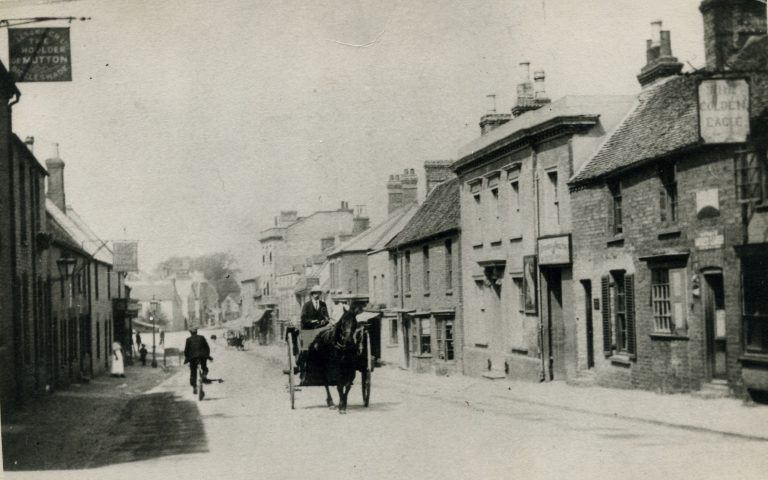
Find out more about Stratton Street and it’s history including the Golden Eagle Inn where Sarah spent her last night of freedom here at Biggleswade History Society: https://www.biggleswadehistory.org.uk/research/roads/stratton-street/
Inquest Juries
A rare image of an inquest jury inspecting a body from 1829: https://www.thelancet.com/journals/lancet/article/PIIS0140-6736(13)60078-1/fulltext
Poisoning research
Information about the 1839 parliamentary audit into arsenic poisoning deaths can be found here. https://sites.dartmouth.edu/dujs/2008/02/21/sensational-murders-a-poisonous-history-of-victorian-society/#:~:text=More%20striking%20than%20this%20imbalance,one%2Dthird%20of%20all%20poisonings.
The chemistry world podcast about arsenic including the case of Humbug Billy can be found here: https://www.chemistryworld.com/podcasts/arsenic-trioxide/2500445.article
The podcast I mentioned about the Dandelion Poisoner can be listened to here: https://www.audible.co.uk/pd/Agatha-Christie-and-the-Dandelion-Poisoner-Podcast/B0CCSPLCGB

Domestic Violence and Abuse in Victorian Britain
This paper on the history of domestic violence from the University of Liverpool gives a good overview: https://www.liverpool.ac.uk/media/livacuk/law-and-social-justice/3research/Working,Paper,No2,-,Domestic,Abuse,in,England,and,Wales,1770-2020.pdf
Victorian attitudes towards women
Here’s an article from SARAH KÜHL at the University of Oxford contrasting Victorian attitudes of the angel in the house to the Fallen Woman by looking at the poem which coined the term, angel in the house and William Holman Hunt’s painting The Awakening Conscience. https://open.conted.ox.ac.uk/sites/open.conted.ox.ac.uk/files/resources/Create%20Document/The%20Angel%20in%20the%20House%20and%20Fallen%20Women_Sarah%20Kuhl.pdf
Show Transcript
Dramatic Intro
It’s late at night on Wednesday 22nd March 1843. If there is one thing that Super Intendant Edwin Blunden does not miss about London, it’s the biting wind off the river Thames. He has been back in the city for less than 24 hours and yet somehow has ended up on the mudflats at Trig Lane stairs whilst he waits near Broken Warf for an informant.
His old colleague Woodbridge hunched against the wind next to him, is attempting to keep his pipe alight and failing.
The river is restless, dark but never as dark as the sky above it. Specks of light on the far bank shift in and out of view through a cold mist.
Then shuffling towards them Edwin makes out a figure, with a strange staggering gate, shifty looking. As he gets closer Blunden can see that he wears a battered cocked hat and tattered tailcoat, the fashion of 50 years or more ago.
No words are spoken but the shady figure nods his head, and the policemen follow.
Although the hour is late there is always work happening at the docks and wharfs, always someone moving goods or hammering things into place. They make their way up the slope towards Thames Street and then suddenly the dark figure they are following disappears; he has dived into the shadow of a doorway even darker than the night around them. Woodbridge nods his head to Blunden and raps his cane on the door opposite.
“Open up! Open Up! In the name of the law!”
The door opens a crack, and a meagre light slithers its escape. A woman with a warty face, glares out at them.
“What does the law want ‘ere with us. We’re law-abiding people ‘ere?!”
Blunden steps forward.
“We are here for the apprehension of Mrs Sarah Dazley and one Samuel Stebbings lately of Wrestlingworth in Bedfordshire, who we believe are lodged here for the night.”
The woman sighs, lets the door swing open saying.
“Well you better come in, then.”
***
The following morning, Thursday 23rd March the Mansion House, court room presided over by the Lord Mayor of London.
Edwin Blunden’s prisoners, Sarah Dazley and Samule Stebbings, have not said a word to one another since they arrived, although they are not quite Blunden’s prisoners yet, this is why they are here to get permission to take them back to Bedfordshire for the inquest into William Dazley’s death. Somehow word must have got out, because there are more newspaper men than Blunden remembers ever being present in court before. But maybe there are just more newspapers now he ponders.
The Lord Mayor William Magnay is a newspaper man himself having been Master of the Worshipful Company of stationers and newspaper makers. Though he was concerned with publishing and printing the things, not reporting for them. He’s 48 and a year away from being made a Baronet, he is following in his father’s footsteps being Lord Mayor for the year of 1843.
When it is Blunden’s turn, he steps forward deferentially and clearly outlines his reason for being there. He has extensive experience of giving evidence at the Old Bailey, this appearance does not faze him. He ignores the murmurs in the room when he talks of poisonings, of not one husband but maybe two and an infant child. Magnay decides however to question the young woman in Blunden’s custody himself. Blunden smothers a sigh as he makes way for his prisoner.
Sarah Dazley steps up to the bar, and stares around the room calmly. All eyes turn to her. She is self-composed, her glossy auburn hair is visible below her bonnet, her hazel eyes glow almost cat like, her skin is creamy the complexion of the countryside, that city folk of her station dream of, and her mouth set firm, is full and even Blunden is struck by how handsome she is. This is why he did not want her to be questioned. Some of the newspaper men have even stopped scribbling to gawk at her.
“Your name?” The mayor enquires although he knows it. Sarah shows no sign of irritation.
“Mrs Sarah Dazley, sir.”
Mayor: “And what of your station in life? You are widow, yes? What of your husbands? Do you have family, relations?”
“Yes, my lord mayor. I am a widow my husband died some 5 months since. I have a mother and brother living in Potton. My father is dead, he was a respectable hairdresser but he died when I was young and left my family in reduced circumstances. And so, I trained with my uncle to be a dressmaker and milliner. I was married at about 19, too young I fear, and I was married to my first husband Simeon for 6 years. We had one son, Jonah, he was a sickly little mite, and he was taken from me aged just 10 months. When he died, I was already married to my late husband William Dazley, who was also taken from me sir, quite cruelly.”
“And what of these accusations from Super Intendent Blunden here and his colleague from the Metropolitan Police. What do you say about them? They are extremely serious in nature. Do you grasp that?”
Sarah: “I do. I am not an imbecile. And I did not run away as these policemen have insinuated. I left my home in Wrestlingworth because I was abandoned by my fiancé, George Waldock on account of these scurrilous rumours. They have been put about by a woman named Mary Carver who is sweet with George Waldock the man I was betrothed to. Because of her jealous lies, the village turned their back on me, and I needed to find a way to make a living. London seemed as good a place as any to find work. If I had not been abandoned by George Waldock, I would not have left.”
The Mayor interrupts
“This man here, is not George Waldock then? The man whose company you were found in is not your fiancé?”
Sarah attempts to answer but the Mayor raises his hand and turns to Stebbings instead.
Blunden nudges Stebbings, encouraging him to speak.
“No, I am not that man. I am not Waldock.”
“Well, who are you then? Give an account of yourself man?!” The Mayor insists. And suddenly Samuel’s whole demeanour closes up tight whether in fear or artifice.
“I um er um I am um I am Sam”
“Sam who? What is your standing in life man!?”
“Erm um well Stebbings yeah I’m Stebbings, Samuel Stebbings. I dunno what my standing is sir. I am not sure what you mean. I only just met this lady I don’t really know her like. We’ve just been together for a few days”
“Together!? Cohabiting?”
Samuel: “Co whating sir? We’ve been living under the same roof if that’s what you mean or under the stars on one night sir.”
The court room erupts in laughter and the mayor waves away Stebbings. Blunden grabs him and yanks him out of the Lord Mayor’s line of sight.
Sarah’s face has not twitched once throughout the exchange she has kept her gaze fixed firmly on the Lord Mayor throughout. Like a challenge.
So, she does not see a messenger arrive at Sup Int Blunden’s side and hand him a letter. The Lord Mayor ignores this and carries on with his questioning.
“Mrs Dazley. You are accused of poisoning your most recent husband and quite possibly a previous one! It appears that the police officers here wish to compel you to attend the inquest into your second husbands’ death. Do you understand all of this.”
police super Intendant Blunden begins to read.
Sarah: “Of course, I understand sir. As I have said I am not an imbecile” The room gasps at her impertinence but the Lord Mayor now distracted by Blunden reading a letter in front of him does not interrupt Sarah’s testimony.
“And I am glad there is to be an inquest. But I did not poison anyone. I would not dream of poisoning anyone, especially my husband. I was never anything but a loving wife to him. I did not run away because of any of this. I am glad they have dug up his body because then they will know that I did not poison him.”
Blunden coughs.
“Lord Mayor, I have just been brought new evidence, pertaining to the results from the tests carried out on the remains of William Dazley”.
There is a loud gasp and a low murmur creeps around the room, faces are animated, except for Sarah who did not flinch. She keeps her gaze on the Lord Mayor.
“Well tell the court what they say.” The lord mayor demands.
Blunden: “It is confirmed that the body of the deceased, William Dazley contained arsenic. A great quantity of arsenic, enough to poison him many times over.”
There is another gasp in the courtroom followed by mutterings and even a shout of ‘for shame!’ which the mayor quells with his hammer.
Mayor: “What do you say of this now Mrs Dazley?”
Sarah’s face is still . There is no sign of busy calculations happening in her head, no flicker of anxiety.
“I say that he was poisoned.” Another gasp erupts “The medical test is true. And I did say as much when he was sick, that it was like he had been poisoned not like a natural illness. But it was not me who gave the poison. And I am happy to go with these policemen and to the inquest where I will show that it was not me who poisoned him. I was always a loving wife to him.”
The furious scribbling of the newspaper men does not stop until the lord mayor awards a warrant and permission for Blunden to take both Sarah and Samuel back to Bedfordshire to face the coroner. The reporters then rush back to the newspaper offices and some are dispatched up to Biggleswade told to get there as fast as they can, to arrive before the police and prisoners. They will spread the word of Sarah’s appearance in front of the Mayor and her imminent return to Bedfordshire.
Sarah remains defiant for the rest of the day, unfazed by the medical evidence. It is only when she comes face to face with the wrath of her neighbours and the townsfolk of Biggleswade that her composure crumples. When she appears at the inquest the following day, gone is her insolent manner replaced by a dread of despair.
What we will have to decide in this episode and the next is, was this the despair of a woman found out for committing the most terrible of crimes or was it the despair of a woman who felt she was innocent but realised that the whole world had already found her guilty. This time on weird in the wade, we explore why arsenic poisonings were rampant in the 19th century, and consider the evidence given at the inquests into the deaths of Sarah’s first husband and baby. Are there possible mitigating circumstances that might explain why a wife in Victorian Britain would turn to murder? Or do the deaths of Simeon Mead and baby Johnah just demonstrate the callousness of the Potton Poisoner?
General Inro
Hello, I’m Nat Doig, and welcome to Part 2 of the Potton Poisoner. This has been a story that has just run wild through my mind over the last few months. It’s consumed my thoughts like few other stories have. Back in April when I visited Trig Stairs on the mudflats of the Thames at Broken Warf and recorded the waves and footsteps in the gravel that you just heard at the start of the show, I never thought it would end up being a three-part episode. Nor that I’d be contacted by two separate people who know different ghost stories associated with this case. The second ghost story will feature in part three. Today’s episode deals with the run up to the inquests into the deaths of William Dazley, and Simeon and baby Jonah Mead. Though we’re going to leapfrog over William’s inquest and come back to that for part three. It will make sense I promise you. In Part 2 we’ll focus on the events of 1840 which lead to the deaths of father and son Simeon and Jonah. There’s no ghost story this time, I’m sorry. But there is some fascinating history about arsenic poisonings including a case of poisoned humbugs, and some fascinating social history around Victorian attitudes to women and ideals of femininity, as well as their attitude towards domestic violence and abuse. Issues that are just as relevant today as they were in the 1840s. It’s an episode that will set everything up for our final showdown in court in episode three which will be out within a week of this one! Make sure you’re subscribed or following the podcast so you don’t miss it’s release!
A night in Biggleswade
But let’s get back to the story of what happened to Sarah Dazley once she arrived in Biggleswade. The newspaper reporters who had seen Sarah in front of the Lord Mayor of London are quite unequivocal in declaring that she was dramatically changed after spending one night in Biggleswade. It’s something that may not surprise anyone who has been to Biggleswade. But I jest.
You’ll remember the crowds and shouting that greeted the police and Sarah’s arrival into town from the opening of part one of this story. All the newspapers report that it was incredibly difficult to convey Sarah to the Golden Eagle Inn where she was to stay the night. The mob was determined to see her and made it very clear that she had brought shame on herself and the neighbourhood.
But the police managed to get her to the safety of her lodgings for the night. The Golden Eagle was on Stratton Street, a stone’s throw from the Market Square. Biggleswade History Society have a photograph from 1900 of Dairy Man Sydney Chessum and his cart horse Old Tom on Stratton Street. I’ll post a link on the blog. A portion of the Golden Eagle Inn is visible on the right-hand corner of the image along with its pub sign. Now in its place is a modern building housing a newsagents and vaping emporium. It’s so strange to think that this newsagents that I have often stopped in on my way out of town, to buy a drink or a chocolate bar is the site of a once bustling inn where Sarah Dazley, the Potton Poisoner spent her final night of relative freedom. And it was not an uneventful night either.
Sarah would not have realised it but what she spoke of that night with the women who sat with her, would seal her fate to a certain degree.
The inn was a middling sort of place looking at census records, it wasn’t one of the more famous and well-appointed coaching inns that Biggleswade was renowned for, but it wasn’t a dive either. Later in the 19th century and early 20th many respectable single men lodged there, market gardeners, grooms, others who worked in the town’s fancier establishments all lived at the Golden Eagle until it was closed in around 1920. The image from 1900 makes it look cosier, more welcoming somehow than the larger hotels and inns in town.
Back in 1843 it was the perfect place for the police to house witnesses who were to give evidence at inquests and trials. Sarah was not yet charged with murder. She was in police custody but not yet committed to gaol. We also know from census records that Super Intendent Blunden lived only a few doors away on the High Street, but it would not have been seemly for a man to sit with Sarah to keep an eye on her throughout the night. Instead, two local women were chosen to be her companions for the night.
It seems Sarah was chatty with them. It’s hard to imagine what it must have been like for the women asked to sit with Sarah now that she was notorious. It’s hard to pin down who these women were exactly but they’re named as Fanny Simmons and Mary Anne Nibbs. I have found records from Potton, Sarah’s home town, for a Fanny Simmons who would have been just 17 or 18 at the time. There is also a Nibbs family in Potton with various Mary’s and Anne’s of different ages. As it appears that at least one of the women knew Sarah before her notoriety, these finds on the census records could be the women who stayed with her. Women from the town she grew up in. The following is gleaned from witness statements from Sarah’s trial in July 1843.
Sarah and Mary Anne Nibbs shared a bed in the Golden Eagle Inn, Fanny possibly slept on a truckle bed on the floor or sat in a chair. The room would have been small, stuffy even as the women lay awake talking. Like women over the centuries have done when sharing a room, for whatever reason, especially if they know one another.
Did Sarah tell them about her escape to London and how she was apprehended? I’m sure she must have done but as this was not relevant to the court case, we only hear about a snippet of their late-night conversation.
Fanny and Mary Anne must have asked Sarah about the accusations against her or maybe she volunteered this information but the conversation they had was reported like this:
Mary Anne: So if it’s all gossip, how do you say your husband passed away Sarah?
Sarah: He had a shivering fit and died, Mary Anne.
Mary Anne: And you sought help for him when he was poorly?
Sarah: I went with Mary Carver, to Potton to see Doctor Sandell to get some pills for William. But Sandell would not sell me any. That Mary Carver is lying, she says that I threw away the pills into a ditch but I didn’t as Sandell would not sell me any so I had none to throw away.
Fanny: Yeah, but I heard tell that you said you wanted 7 husbands in 7 years! Now that’s not going to look good, is it?
Sarah: That’s a lie too Fanny, I said that I should have 7 husbands in 10 years.
Gasp
Sarah: Fanny?
Fanny: Yes, Sarah?
Sarah: Do they hang much these days, the judges?
Fanny: I wouldn’t know Sarah.
Sarah: Well, it’s not as if anyone saw me buy any poison or give any to William.
This conversation is made much of in court. And I want you to remember it for a couple of reasons. There is one thing that Sarah says in this exchange which is not picked up on in court and that’s about the pills she says she did not manage to buy for her husband. Keep that in the back of your mind when you hear the evidence of Doctor Sandell later at the inquest and the trial which we’ll cover in episode three.
What the hearings do latch on to, is that Sarah asks about hanging and that she says no one saw her buy poison or administer it.
Let’s deal with the asking about hanging. This seems like a very sensible question to ask whether you are guilty or innocent, especially if you have just been surrounded by an angry mob baying for your blood and convinced of your guilt. So, I don’t think it’s incriminating to ask about rates of hanging though Fanny seems to be a poor choice of person to ask. Yet this is given much weight in court as if an innocent person would never think to ask about executions.
The admission that no one saw her buy or administer poison is the line picked up in the papers as most incriminating for obvious reasons. They take it as if she said this because she’s confident that she got away with it. But I wonder whether she said it exactly as the two women remember. Maybe she did mean, I got away with it, and they’ll never be able to prove it! Or maybe she simply meant no one can possibly say they saw me do these things because I didn’t do them. All nuance is lost in the reporting of these lines which are taken down shorthand and regurgitated by the press reports with little explanation. The women don’t appear to have ever been cross examined.
The seven husbands in seven or ten years becomes almost a slogan for the case. The Potton Poisoner who wanted 7 husbands in as many years. I wonder again though if the nuance of this statement which Sarah does not deny, is missed in reporting. After losing two husbands during the first three years of the 1840s even if their deaths were completely natural, could prompt someone with a dark and macabre sense of humour to remark, “at this rate I’ll have 7 husbands in ten years.” And Sarah did seem to have a macabre turn of phrase and a flare for the dramatic.
Arsenic
Now before we look at any of the evidence in any of the inquests or the trial we need to know a little bit about arsenic and why was it so easy to get hold of and why was it poisoning so many people in the 19th century?
Arsenic, element 33 on the periodic table occurs naturally with many minerals and metals. It had been known as a poison for centuries and by the 19th century was nicknamed “inheritance powder” because it had a reputation of being used by the wealthy to kill off inheritance rivals. There had certainly been high profile poisonings throughout the first three decades of the 19th century in England and France.
So why was it possible for this toxic substance to be on sale in a bakers in Bedfordshire? Well because it was on sale just about anywhere and used for all kinds of things. In a local shop it was likely to be purchased as a rat poison, insecticide, or a weedkiller. But it was also found in poisonous levels in medicines, face creams, green cloth dyes and wallpapers. The most common everyday form of it was arsenic trioxide which was used as a rat poison. In 1843 there was no control over its sale. Practically anyone could buy it.
It was a white crystalline powder very similar to sugar or salt though could appear as fine as flour or plaster of Paris, and in 1858 this similarity to sugar and plaster of Paris led to it being mixed into a batch of sweets by mistake which were then sold in Bradford. At least 15 people who ate the peppermint lozenges sold by “Humbug Billy” died. It was common back then to cut ingredients like sugar with substances called “Daff,” in this case plaster of Paris which would make the sugar go further. This wasn’t illegal. But on this fateful day in 1858 Humbug Billy’s sweets had been mixed with sugar and arsenic, rather than sugar and plaster of Paris by mistake, and to deadly effect. Humbug Billy’s case was some 15 years after ours and the laws were even laxer in 1843.
But the authorities were aware of the problem. You see most deaths to arsenic, had always been like humbug Billy’s case, they were accidents or in many cases deliberate but suicides. And poisonings although still rare as a causes of death, were worrying parliament enough for a select committee to investigate deaths by poisoning in 1839. They studied an audit of coroners verdicts for death by poisoning in 1837-8 in England and Wales which recorded 555 deaths by poison (obviously this only included deaths investigated by a coroner so the true figure would be higher.) Of that 555, 194 were accidental poisonings, 242 were suicides and only 9 were recorded as murder. However, of the 555 deaths a third (186) were caused by arsenic. And although parliament were alarmed by these figures the law was not changed until some 12 years later when the Act to regulate the sale of arsenic came into effect in 1851 8 years after the Potton Poisoner case. It also appears that although most poisonings were accidental or suicide, the new Act’s motivation was to tackle arsenic use as a murder weapon. No doubt the case of William Dazley alongside a handful of other arsenic murders in the 1840s spurred on this rather blinkered view of how to deal with the problem. Which is why poor Humbug Billy’s lozenges could still easily end up with arsenic in them some 7 years after the new regulations came into force. I must thank the work of Dartmouth Undergraduate Journal of Science for the information about the parliamentary audit of poisoning deaths. And Humbug Billy’s case is covered in a short podcase episode by chemistry world, links as ever on the blog.
The Bradford sweet poisoning did lead to new legislation in the 1860s (the wheels of law roll slowly) which made adulterating food with things like plaster of Paris unlawful. I think it was also at around this point that arsenic was supposed to be dyed so that it could not be so easily mistaken for sugar or salt. Yet in the 1920s when the famous dandelion poisoning happened in Hay on Wye, Herbert Rowse Armstrong was able to easily get hold of white arsenic powder to poison his dandelions, and also as found in a sensational court case his wife. There’s a great new podcast out all about the case and how it intertwines with the novels of Agatha Christy on Audible. As always, I’ll pop a link on the transcript and notes on the blog. Armstrong acquired the arsenic from a local farmer it would seem.
So, all the way back in 1842 when it’s claimed that Sarah bought some arsenic from a shop in Potton to kill some rats, that was as easy for her to do as it was to buy a bag of flour or a carton of salt. Records were often kept by shop keepers of who bought what especially poison and medicines, but it wasn’t guaranteed. And in Sarah’s case there seems to be no written evidence, but we’ll come to that later in the next episode because it seems possible that written evidence or not, she did buy arsenic in the summer of 1842.
So, in the early 19th century, with all these poisonings happening, and the government holding an investigation into it, its not surprising that science was also on the case and trying to find a reliable method for detecting arsenic poisoning. And in 1836 just 7 years before this inquests and trial for the murder of William Dazley., a reliable test was finally devised. In fact, the Marsh test as it is known was so reliable, a version of it was still used to detect arsenic well into the 1970s.
It was a murder trial in Kent which prompted James Marsh out of frustration to invent the test as there was clearly a need for it. And it’s first use in a murder trial was in France in 1840, just three years before Sarah’s. This was cutting edge science of its day and the Wrestlingworth poisonings was one of the very first times the test was used in the UK to prove arsenic poisoning at an inquest and murder trial.
I am no chemist, and I really am not going to do justice to how this test works. I’ll share an image of the apparatus from the 19th century, which looks like a complicated rig of jars and pipes and U-shaped test tubes, and bowls with heating and cooling and precipitate being gathered.
A sample of tissue or body fluid from a body suspected of being poisoned was placed in a glass vessel with some zinc and acid. This would create arsine gas if arsenic was present. Igniting the gas mixture would oxidise the arsine into arsenic and water vapour. This would cause a silvery black deposit to form if the gas was forced into a cold ceramic bowl held into the jet of a flame. By using test quantities of known amounts of arsenic the level of staining could be measured and compared with results. It was extremely sensitive and minute amounts of arsenic could be successfully discovered.
And we might as well make it really clear here and now, William Dazley Sarah’s second husband did die as a result of arsenic poisoning. The medical men tell his inquest this in March 1843. They knew from the moment they opened the coffin because his body was so well preserved. It had to be arsenic, it’s what it does, it kills even the insects and bacteria that cause decomposition. Even though they suspected arsenic they did the Marsh test 5 times, independently and each time it showed enough arsenic to kill a man easily. The question never really was how William died but how the poison came to be ingested by him. Was it an accident, deliberate by his own hand or deliberate by another’s.
And I’m going to tell you now that the jury at William’s inquest decided after hearing the evidence it was his wife’s deliberate hand that gave him the poison. Don’t worry you’ll get to hear this evidence in the part three of the story. It’s pretty much the same evidence given at trial. But with some crucial inconsistencies, and contradictions and that’s why I want to devote part three to the William’s inquest and murder trial.
Now telling you all of that about William’s inquest may seem counter intuitive but bear with me. I’m going to hop over the first inquest and head straight towards the second and third. I’m going to deal with William’s inquest and his murder trial together in the final episode and it will make sense I promise. Trust me. We’re going to head straight to the inquests of Simeon Sarah’s first husband and her baby Jonah because they deal with what happened in 1840 two years before William’s death. And knowing about what happened then helps to understand what happened later.
Exhuming Simeon and Jonah’s bodies the second inquest
Both inquests were commenced in early April together, only for both to be adjourned so that the bodies of Simeon and baby Jonah could be exhumed.
Newspaper men were present for the exhumation, and many ran this poignant description of the occasion:
“A more extraordinary scene was never witnessed. The early hour of the morning the awful stillness that the country for miles around covered with snow, the singular group collected under the walls of the church mysteriously discussing the various points of suspicion that had been developed and the little knot of villagers that stood near the graves partly quaking with cold and partly shivering with horror at the dreadful deeds that had been committed formed indeed a picture not easily to be forgotten.”
Simeon and little baby Jonah’s coffins are conveyed to a barn where herbs are placed around them as the jury of the second inquest gathers to inspect the remains.
And unlike William Dazley their remains have decomposed. No unusual preservation appears at first glance. But what can be extracted is taken away to Bedford hospital by two medical men for testing.
In some ways the second inquest was more of a spectacle than the first, even described by some as a circus, with one group of witnesses being willingly torn away from their own wedding celebrations to appear. It almost seems like those who didn’t get to speak at the first inquest made sure they had their say in these latest ones.
Simeon’s inquest was shorter largely because as soon as the medical men from Bedford were called, they explain that they could find no traces of arsenic in Simeon’s remains. They in fact say they could find no traces of poison.
Yet before they are called, we do hear some interesting testimony about how Simeon died, some of which is really quite gruesome.
We learn that the poor young woman whose job it was to lay out the dead in the parish, went into Simeon and Sarah’s house to perform her solemn task. Only to be so shocked by Simeon’s appearance, that she had to run from the room outside into the fresh air where she grabbed hold of a hedge to steady herself from fainting.
And what was it about poor Simeon’s appearance that so terrified her? It was that his tongue was so swollen, discoloured and distended that his jaw had dislocated. The newspapers report that the jaw of his skull was gaping in a most unnatural manner when his body was inspected in the coffin.
We also learn that his illness was a strange one. His throat and tongue swelled up so he could not swallow, eat nor drink. He also had a fever, he frothed at the mouth and his breath stank offensively. None of these symptoms on their own tie in with arsenic poisoning. Apart from one witness who claims Simeon did have the symptom of pain in his bowels, as you would get with arsenic poisoning, everyone else says he did not vomit and did not have a painful abdomen. That lone witness who vouches for these arsenic poisoning-like symptoms is in fact Elizabeth Dazley the mother of William, whose death had already been attributed to Sarah poisoning him.
I can understand why Elizabeth would want Simeon’s illness to be poisoning like her sons. It would mean her son was not alone in being a victim. It would heap more punishment on Sarah. There are all kinds of reasons why she would want Sarah to be guilty. But she really is the only witness to claim anything like this. Others state he did not have pain in his bowels nor was sick.
Elizabeth gives further evidence though in terms of Simeon and Sarah’s relationship and it is this:
Sarah and the deceased were my neighbours, and they did quarrel frequently, one day Simeon wanted a shilling off his wife, and she would not give it him, for he would only spend it on drink. But he was a big man, a powerful man and he knocked her to the ground and took it from her pocket by force. She came to me after this happened and she said to me “Damn him, I’ll poison him but what I’ll get rid of him.”
The violence in this evidence appears to be true, others at different times report this incident as evidence of the unhappy marriage. But what is a little harder to corroborate is the explicit declaration that Sarah said she would poison her husband. Because if Elizabeth Dazley did believe Sarah had poisoned Simeon, why did she take her in when Simeon died? and why did she go along with the marriage of her eldest son to Sarah? Some reports leave out the declaration about poisoning and then the evidence reads in a far more relatable way. That Elizabeth a friend and neighbour to Sarah, witnesses her being beaten by her husband and wanted to help. She gives her a place of safety to stay. She is happy for her to marry her son. This makes far more sense than Elizabeth having any serious belief that Sarah was capable of murder back in 1840 when this happened.
Simeon’s little sister Anne who is 14 when giving evidence and so under 11 when Sarh was married to Simeon, also testifies to the turbulent and unhappy marriage. Anne says she heard Sarah once yell at Simeon “Blast you! I wish you had never come near me!” She also testifies that whilst ill Simeon had said he wished to get better and to live happily with Sarah but also that he told her “My sins lay before me. But I never should have done what I have done if it had not been for you.”
It seems Simeon admitted having been a violent husband but sadly still blamed Sarah for his violence.
Domestic Violence in Victorian Britain
I’m going to spend a very shot time looking at domestic abuse and violence in Victorian Britain. I won’t dwell on this for long, but I do think it’s important to understand a few things. Firstly, the Victorian’s tolerance for violence was greater than our own. Corporal punishment for children especially at school was considered by many a good and necessary thing. Saying that throughout the century there was a growing concern about the effects of violence on women and children. Violence in the home had until the 19th century generally been seen as a private matter. Local villages or neighbourhoods could intervene if they felt violence in the home was going too far. “Rough music” could be performed where neighbours would bang pots and pans outside a perpetrators home in protest. However, this could also go the other way and wives who were considered scolds or nags could also be punished by the community.
But during Queen Victoria’s reign concerns about what was then termed wife beaters grew. The prevailing view became that a husband should control his wife through moral rather than physical means. So, wives should still be controlled by their husbands, but the methods of that control should not be excessive. In fact, ten years after Sarah’s trial the 1853 Criminal Procedure Act (also referred to as the Act for the Better Prevention and Punishment of Aggravated Assaults upon Women and Children) was introduced. A landmark piece of legislation where the state was legislating against crimes committed in the domestic sphere and although women could be the ones being violent, overwhelmingly this was legislation to protect women and children against violent husbands and fathers. Remember, in the previous episode I mentioned how poisonings were treated as a crime against the community and god as much as against the individuals involved. The attitude was shifting and many in Victorian Britain felt that the state needed to intervene within the home for the good of the individuals as well as for the greater good of society.
But although this was a landmark piece of law in reality it did little to actually help women and children tapped in abusive and violent households. Prosecuting a spouse or parent was incredibly difficult and the punishment of 6 months in prison was likely to affect the family terribly through loss of income. A working or even middle class mother with children to feed could not afford to prosecute a violent husband.
There was no socially acceptable escape from such a marriage either. Divorce was practically unthinkable even in the highest echelons of society. It wasn’t until 1857 that women were able to divorce their husbands when Matrimonial Causes Act allowed women to divorce on grounds of cruelty (until that point women could only seek a divorce if they discovered they were in a bigamous marriage.) But even with this change most women could not afford to seek a divorce for financial and social reasons. It took decades more campaigning by women like Frances Power Cobbe for things to improve and it wasn’t until the 1960s that the divorce laws in the UK changed to an extent that they were affordable for the average person.
So, for Sarah in the 1830s and early 40s there was no affordable nor socially acceptable way for her to escape a violent and unhappy marriage. She would be expected to stay put or be shunned. It was really only in the major cities where a woman could possibly reinvent herself as a way of escaping, where people would not know her. In the villages and towns around Biggleswade, there was no escape, to leave your husband was to mark you out as what the Victorians would call an unnatural and deviant woman.
Sarah is portrayed by the press from the start as an unnatural woman, not so much because she poisoned anyone but because of her attitude towards her husbands. Much is made of the fact that after the violent attack from Simeon, she publicly said she would not suffer a man be violent to her again. That she stood up to her husband and argued back at him in public. The fact that she spent time in other men’s homes, even if this was for work was seen as scandalous. And when it came out at the inquest and trial that she had defied one husband to go to a local fare when he had asked her not to, showed to the Victorian that she was a woman who could not be controlled through violence nor through moral persuasion.
There was this moral preoccupation with the true nature of women in Victorian Britain. Women were seen as naturally weaker and more emotionally fragile than men, suited ideally for domesticity. Women could be seen as morally superior to their husbands, acting as a support and guide to them through piety and gentleness. There were guides, books, pamphlets and articles all written to help women become this ideal of an angel at the hearth. However, there was a real Victorian fear that a woman’s nature was a brittle one, they could easily fragment into unnaturalness, and become women who were angry, insolent, slovenly, highly emotional, and ungovernable by their husbands and fathers. These unnatural women could tempt and seduce men, abandon their domestic duties and children, and generally corrupt society. The virgin and the whore were concepts of womanhood that the Victorian’s oscillated between almost uncontrollably.
In fact, in the Westmoorland Gazette on 22nd April 1843 as well as reporting on the inquest into Simeon and Jonah Mead’s deaths they run an unrelated article about what a wife should and should not be. It reads like this:
She should be like a snail, always keep within her house, but she should not be like a snail and carry all she has upon her back. She should be like an echo always speak when spoken to, but she should not be like an echo, have always the last word, She should be like a town clock always keep time and regularity, but she should not be like a town clock, speak so loud that all the town may hear her.
So with pearls of wisdom like that being shared in the newspaper as editorial fact not even a letter sent in from someone with extreme views, it’s historically understandable that the newspapers portray Sarah as the unnatural woman, the bad wife. Even before Sarah is found guilty of any serious crime, she is guilty of being a deplorable wife, mother and woman. Many of the early headlines read “The despicable poisonings by a wife.” Sarah is the devil at the hearth all decent people must be terrified of!
When she is convicted of murder at a criminal trial, unlike today, mitigating circumstances were not considered. The Victorians had no concept for the psychological stress and trauma that domestic abuse and violence cause. Psychology as we know it had not been invented. To them the easiest explanation for Sarah’s behaviour was that she was one of these unnatural women, just look at her behaviour even before she murdered anyone! She was to be either hated or pitied depending on whether you were a reactionary or a reformer. Reformers believed that such unnatural behaviour came about because of the evils of alcohol, poverty, and lack of religious vigour, the devil was found in these circumstances causing sin. Whilst a reactionary would say Sarah was just bad to the bone, lots of women were, that’s why they need to be controlled so closely by the menfolk.
So although some attitudes towards domestic violence were changing in the Victorian times and Sarah’s own defence lawyer says that one thing guaranteed to upset a wife is rough treatment from a husband. No one puts forward a defence that Sarah poisoned her husbands out of desperation and fear. That is very much a late 20th century and early 21st century perspective. As we’ll learn in the next episode Sarah does say she had a way of dealing with violence in her marriage to William, but we never hear what she thought or felt after facing the attack on her by Simeon.
Back to the second inquest
But none of the evidence given by neighbours ultimately mattered because the medical men form Bedford stated that no trace of poison could be found in the remains of Simeon Mead, the Coroner on hearing this cut short the inquest and the jury passed a verdict that:
“Simeon Mead died on the 10th June 1840 after an illness of 6 days but that there was no evidence to show whether his death was caused by natural causes or otherwise.”
Except that wasn’t the end of it, not for the family and neighbours. You see someone had said that they believed arsenic had not been used to poison Simeon, but a substance called Corrosive Sublimate was used instead. This was another highly dangerous compound more commonly known today as mercury chloride. And you’ve guessed it the Victorian’s used it in all kinds of things! As a disinfectant, preservative, in early photography and in medicine! It was used to treat syphilis and often did a lot more harm than good. It was used in some famous poisonings, accidental and deliberate right up until the early 20th century. I have no idea if the doctors tested or could test for it, though their evidence says there was no sign of poison not no sign of arsenic so maybe they did test for more than one poison. But the rumour was enough. And although Simeon did not have the classic symptoms of corrosive sublimate poisoning either many believed that this was what had killed him, given to him by his wife, and she had got away with it as the medics looked for arsenic. And to this day even though the inquest gave the equivalent of an open verdict, and a grand jury dismissed the case so it did not go to trial. Sarah is remembered as poisoning both her husbands.
Baby Jonah
Proceedings then just rolled round to the inquest of baby Jonah and it is at this point that it appears that every villager in Wrestlingworth is called and the wedding party turn up to give their evidence, which the papers note was of no material value at all. It’s as if every local neighbour wants to have their say. And maybe this was a form of community therapy, a way to process what had happened in their midst. There must have been a lot of bewilderment and guilt felt by Sarah’s neighbours. She had been declared a murder by the first inquest and suspected of poisoning her own baby, a child many in the village knew and had looked after from time to time. Why had they not seen the signs? Could they have prevented the little one’s death? These must have been the questions going through many of their minds.
The evidence given can be categorised as from either medical professionals or neighbours and relatives.
The evidence of family and neighbours falls into two differing camps.
In camp one, Sarah was and I quote a “brute of a mother who did not keep her child clean like other mothers do.” The child was healthy until his final illness and Sarah was heard to say she wished the baby dead on many occasions.
In camp two, we hear no complaints of Sarah’s parental skills, and we learn that the baby was a sickly child from birth, with a terrible persistent cough for many weeks before his death, Sarah is described as distraught when he dies.
It may not surprise you to learn that camp one is made up of the relatives of Simeon and Jonah Mead and Elizabeth Dazley, mother of murdered William. Unfortunately for Elizabeth, her husband also a William, undermines her witness testimony by saying that the baby was a sickly child after all. But he does quickly jump back into camp one by saying that on the Sunday before little Jonah died, Sarah visited with the baby and William fed him some sop made up of milk, sugar and water but Sarah complained saying of Jonah “Damn him, he’s always stuffing his gob.”
Camp two is made up of women who did not appear at William or Simeon’s inquest nor later at the trail. They are women who stayed with Sarah during her confinement and or helped look after Jonah in the village. The evidence from them is that no one saw the baby vomit when he was ill. But they all report on his cough and general malaise being his illness.
Witnesses in both camps do testify that Sarah purchased some medicinal powder (one witness says from a Mr Pratt of Potton I can’t find a Pratt in Potton, but I did find a Mr Parrot whose a butcher, but that seems an odd choice to buy powders from but maybe he did a sideline in them.) within an hour and half of the first powder being given to the baby he was dead.
But all the contradictory witness testimony is overshadowed by the medical men of Bedford’s evidence. Hadley and Hurst are back and they say that there was some tissue preserved in little Jonah’s coffin, of the stomach and bowel area. This tipped them off to there being arsenic present. Though the preservation is not as extensive as that of William’s body. They perform their experiments with the Marsh test apparatus and declare that some arsenic was found. It appears less than was found in the samples from William Dazley. They appear to need to do more extensive testing to get a result. But none the less both confirm that arsenic was found in little Jonah’s body, enough to cause death of an infant.
It seems the jury have no choice but to say that Jonah Mead died of arsenic poisoning. But do they have proof that Sarah deliberately poisoned him?
The jury decided they had enough evidence and again say that Sarah Dazley deliberately used poison to kill her own kin.
But no one saw her administer poison, no one says they sold it to her, and there is ample evidence that the baby was very poorly already. Maybe if she had not been found guilty of poisoning William at the first inquest, they’d have given her the benefit of the doubt that the arsenic had somehow found its way into the baby’s medicinal powder by accident? Maybe. There were enough cases of accidental poisonings that this should have been explored. But with it being three years since the poisoning took place, maybe it was just too difficult to track down what may or may not have caused it? But the evidence seems extremely thin in pointing to a deliberate act. They give no motive other than the group who claim she was a bad mother. But even Elizabeth Dazley who in one breath calls her a brute of a mother, admits she was not a cruel mother, it was just that she did not keep the baby as clean as Elizabeth felt she should. Elizabeth and that group of witnesses have every reason to push the bad mother angle. To only see the worst in Sarah, they believe she killed their son or relative.
The other group have no reason to contradict these grieving neighbours and yet they do say that Sarah wasn’t the brute she is made out to be. Why would they lie?
The Drs seem far less certain about their result when it comes to Jonah’s death than they are William’s. They can not rule out any other cause of death because the lungs and other parts of the body were not preserved.
It all feels very unsatisfactory.
We don’t hear from Sarah at these inquests although she was there, she either was not interviewed or the newspapers chose not to report what she said.
What we do know is that prison life has been hard on her.
Bedford Gaol
Straight after the first inquest Sarah is whisked away to Bedford Gaol, and I have seen her admittance entry which states she is 5 foot 5, has auburn hair, hazel eyes and a brown complexion (freckles I assume) The record states that she can read a little. Her conduct throughout her time in gaol is very good. And Through out her whole time there she maintains her innocent refusing to confess to any wrongdoing at all.
It is not long into her imprisonment that she develops an illness of the throat. Something the newspapers find ironic as both her husbands complained of pain in their throats before they died. She is allowed at times to stay in her bed in the gaol, because she is so poorly. And on her appearance at the inquests of Simeon and Jonah the papers report how much she suffers with this disease of the throat and how wretched she now appears.
Grand Jury
There is one other official hearing before Sarah is to face the murder trial and that is the grand jury which will decide which crimes she will be tried for. It may seem a forgone conclusion that she will face a murder trial for the deaths of both William and her baby because both inquests found her guilty of administering poison. Except that isn’t how it goes in front of the grand jury. When they examine the evidence, they decide that it is the case of William’s murder alone that she should be tried for.
It appears that the grand jury are not as convinced of the evidence when it comes to the death of baby Jonah, just as I am not convinced of it. I think they make the right decision. We’ll never know how baby Jonah got arsenic into his little body and it could so easily have accidently found its way there mixed up in another white powder or granules like sugar, salt or flour, or in the medicinal powder he was given. The evidence around all of this is too weak to really know for sure what happened.
But what the grand jury did find was that there was enough evidence from the inquest and subsequent investigations to prosecute Sarah Dazley for poisoning her husband William Dazley and that is what we will look at next time on Weird in the Wade,
We’ll look at the year 1842 in the lives of all those involved. We’ll compare the accounts given at the inquest and trial, interrogate the differing takes and contradictory statements given. We’ll attempt to untangle the twisty timeline of events. There’ll be salacious local gossip, teenage pregnancies, pills, powders, and a dead pig along the way. And at the end of it there is a guilty verdict, you know that. But if you had been part of that jury at the inquest or the trial into William Dazley’s death, could you have made up your mind? Next time on Weird in the Wade.
End credits
Thank you for listening to Part 2 of the Potton Poisoner, Part 3 will be out in the next week and by Monday 4th September at the very latest.
I’d like to say a big thank you to John Hawkes for his continued support of the podcast it’s really appreciated thank you John!
If you’re enjoying my podcast please do follow, subscribe, rate and review it.
The transcript to the show and notes and links from this episode can be found at weirdinthewade.blog.
You can find the pod on social media as weirdinthewade there’s a link in the show description.
Weird in the Wade is researched, written and presented by me Nat Doig.
Additional crowd voices by Savigear and McOwen.
Theme music and the Potton Poisoner music by Tess Savigear.
All other music and additional sound effects are from Epidemic Sound.

 Weird In The Wade